
Restructuring & Distressed Investing Certificate Program
In collaboration with

Get the brochure
View the full syllabus for details on faculty, guest speakers, and learner benefits.
Program overview
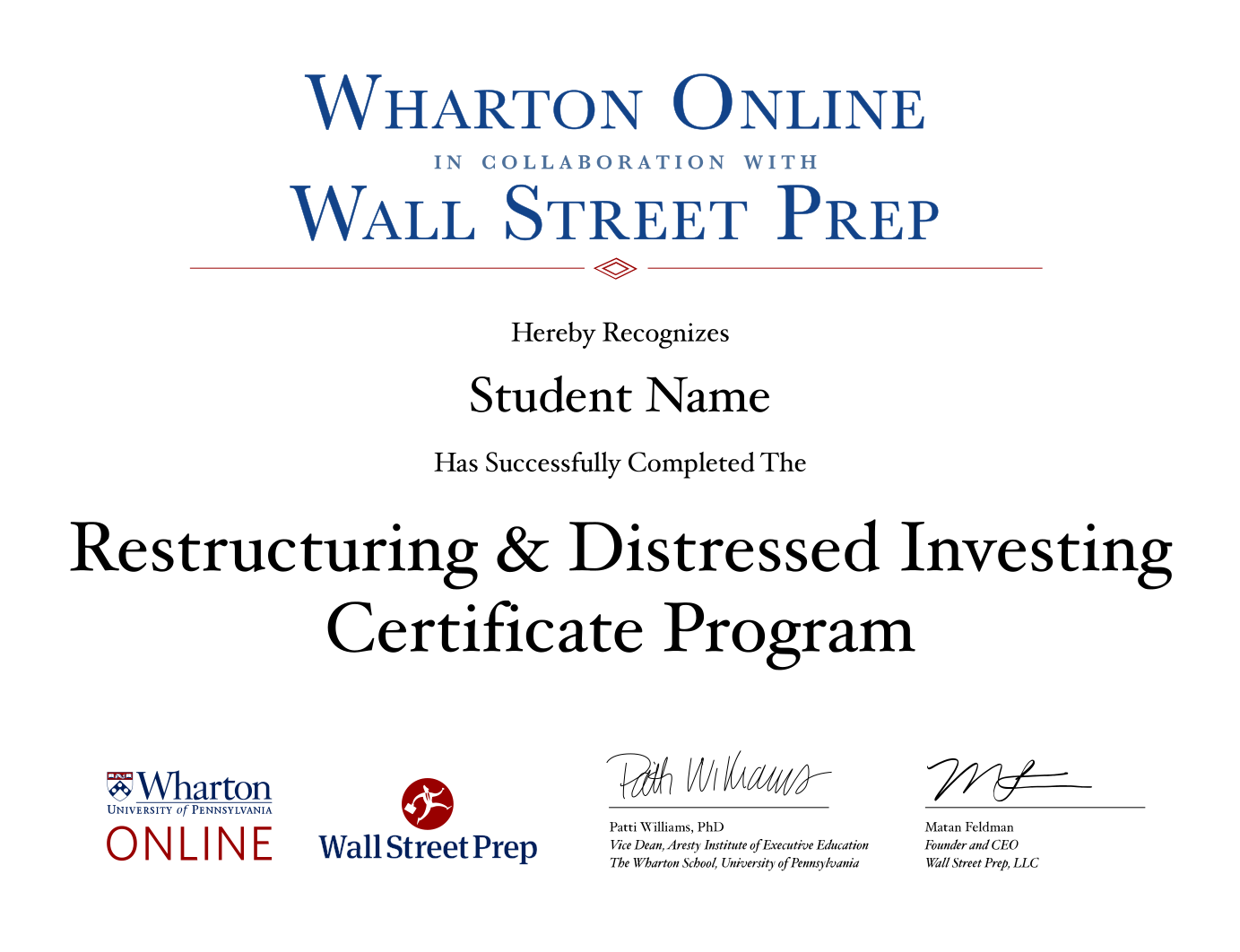
Earn Wharton’s globally recognized certificate in Restructuring & Distressed Investing
-
Gain a practical foundation in one of finance's most complex disciplines
This program is designed for investors evaluating distressed opportunities, credit professionals navigating troubled portfolios, advisors guiding clients through restructurings, and attorneys advising through bankruptcy proceedings.
-
Learn from leading restructuring professionals, distressed investors, and Wharton faculty
You’ll learn directly from experienced restructuring practitioners and distressed investors alongside Wharton faculty and Wall Street Prep trainers who prepare teams at leading credit funds, PE firms, investment banks, and restructuring advisory practices.
-
Earn a globally recognized certificate
Upon successful completion, participants receive a Wharton Online certificate, earn 65 CPE credits, and join a global network of restructuring professionals, credit investors, and turnaround advisors across 100+ countries.
The Credit Cycle is Turning. Be Ready for What Comes Next




Built by the Industry. Credentialed by Wharton Online & Wall Street Prep
This program is a collaboration between Wharton Online, Wall Street Prep, and the leaders in the restructuring and distressed investing industry — bringing together leading distressed investors, restructuring advisors, turnaround operators, bankruptcy attorneys, and distressed M&A practitioners to create the most comprehensive program of its kind.
Program speakers come from top firms including












Who This Program is for
Built for Professionals Across the Restructuring Ecosystem
Whether you seek out distress — or distress finds you — this program is designed for professionals who need fluency across the discipline to do their jobs better.
Credit & Special Situations Investors
Restructuring & Turnaround Advisors
Bankruptcy & Creditor Rights Attorneys
Private Equity Professionals
Investment Bankers in RX & Lev Fin
C-Suite & Corporate Finance Leaders

Applicant profile
The Wharton Online & Wall Street Prep Restructuring & Distressed Investing Certificate Program is designed for professionals from finance, legal, and advisory backgrounds seeking specialized expertise in distressed investing and corporate restructuring.
Applicant Career Levels
Applicant Industry
Countries Represented
At a Glance: Wharton Online & Wall Street Prep Certificate Learners
























































































Applicant Employers Include ...











































Top Roles Applicants Hold
| 1. | Private Equity Associate/VP |
| 2. | Bankruptcy Law Associate |
| 3. | Restructuring Advisor Associate/VP |
| 4. | Hedge Fund Analyst/PM |
| 5. | Chief Restructuring Officer |
| 6. | Private Credit Associate/VP |
| 7. | Rollup Professional |
| 8. | Chief Financial Officer |
| 9. | Small Business Owner |
| 10. | Investment Banking Associate/VP |
Attend an information session
How you'll learn
The Wharton & Wall Street Prep Restructuring & Distressed Investing Certificate Program is an immersive learning experience made up of self-paced video lectures, real-world exercises, industry case studies, and live office hours
8-Week Restructuring and Distressed Investing Program
Gain the skillset of an experienced restructuring and distressed investing professional in eight weeks.
8-10 Hour Weekly
Time Commitment
A comprehensive certificate program designed to fit into your busy schedule.
Self-Paced Online
Learning Experience
Complete the program on our online learning platform at your own pace.
The Same Training Used by Top Financial Institutions
Access the same lessons and methods taught inside the world’s leading restructuring and distressed Investing teams and organizations.
Learn Directly From Leading Restructuring Professionals
Hear directly from industry experts about best practices and emerging trends in restructuring and distressed investing through our guest speaker series.
Tailored Learning Experience
Through Program Electives
Customize your experience based on your specific learning objectives.
Case Studies That
Capture Perspective
Through real-world exercises and industry case studies, get hands-on expertise in bankruptcy processes, capital structure analysis, distressed M&A, and operational recovery.
Weekly Office Hours
& Dedicated Support
Faculty and support staff are with you every step of the way, offering guidance and live office hours throughout the program.
Earn a Certificate from Wharton Online upon Successful Completion
Upon successful completion of the program, your Wharton Online-issued certificate will be emailed to you in a digital format you can use to demonstrate your achievement on your LinkedIn profile and resume.

Program curriculum
Over the course of eight modules, master the complete spectrum of corporate restructuring and distressed investing. From diagnosing financial distress to executing turnarounds and distressed investments, you'll gain hands-on expertise in bankruptcy processes, capital structure analysis, distressed M&A, and operational recovery. This self-paced online program culminates in a closing ceremony and the receipt of a certificate from Wharton Online.
Module 1
Introduction to Distress & Distressed Investing
This module introduces the foundations of financial distress and distressed investing. Participants learn what drives companies into distress, how value is created and redistributed across stakeholders, and how investors and advisors assess risk and opportunity in stressed situations. The module blends financial analysis, legal context, and real-world case studies to establish a shared framework for evaluating distressed companies and investment opportunities.
- What is distress and distressed investing?
- The role of value creation in distressed investing
- Identifying the causes and drivers of distress
- Analysis in distressed investing: Sizing the Pie (Valuation)
- Analysis in distressed investing: Splitting the Pie (Priority & Gaming)
- The legal backdrop of the distressed situation
- Liquidity stress testing and burn analysis
- Case Study: Bayfield Generators
Module 2
Decline, Distress, and Turnaround Management
Participants examine how businesses decline, why liquidity crises emerge, and what differentiates operational challenges from structural failure. This module focuses on diagnosing the root causes of distress, managing short-term liquidity through cash controls and forecasting, and understanding the mindset for effective turnaround leadership. Learners gain insight into how operational decisions directly shape restructuring outcomes and long-term viability.
- Identifying the problem – the financial analysis of Bayfield Generators
- What caused the decline and distress – concepts and cases
- The role of bad management versus bad luck
- The mindset of turnaround management and operational improvement
- The Liquidity Crisis – Control of the cash and the 13-week cash flow forecast
- The Solvency Crisis – Does the company have a right to exist?
- The key questions for understanding the problem and potential paths forward
- Positioning the company for long-term success post-restructuring
Module 3
Modeling the Capital Stack
Participants develop a deep understanding of capital structures and credit documentation, from secured debt to equity and off-balance-sheet obligations. This module demystifies credit agreements, covenants, and intercreditor dynamics, helping learners understand how capital structure design influences outcomes in distress. Emphasis is placed on interpreting legal documents and identifying flexibility, or constraints, within complex financing arrangements.
- Waterfall analysis and creditor priority
- Secured debt: revolving credit facilities, asset-backed loans, and term loans
- Liens, perfection, and subordination
- Unsecured debt: bonds, mezzanine, and convertible instruments
- Off-balance sheet obligations: leases, unfunded pensions, and contingent liabilities
- Credit agreements, indentures, and intercreditor agreements
- Key covenant structures: affirmative, negative, and financial covenants
- Defaults, remedies, and cure mechanics
Module 4
Liability Management Exercises
This module focuses on restructuring the right-hand side of the balance sheet to align a company's capital structure with its underlying business realities. Participants explore creditor priorities, covenants, and the absolute priority rule, while analyzing modern restructuring tools such as liability management exercises. Case studies illustrate how balance sheet restructurings can preserve enterprise value, or shift control among stakeholders.
- Sizing the Pie in order to know how to Split the Pie
- The objective and process of right-sizing the balance sheet to the business
- The hurdles to right-sizing the balance sheet – introduction to covenants
- The absolute priority rule and understanding priorities and subordination
- The recent rise of Liability Management Exercises (LMEs)
- LME case study #1 – Drop-downs (J. Crew / Toys “R” Us)
- LME case study #2 – Non-pro rata uptiers (Serta and following reversal)
- Restructuring for long-term success (Chesapeake Energy, Hertz, SAS)
Module 5
Entering Bankruptcy
This module provides a practical introduction to Chapter 11 bankruptcy and the early stages of the court-supervised restructuring process. Participants learn the roles of key stakeholders, how the automatic stay functions, and why DIP financing and first-day motions matter. Through applied exercises, learners develop fluency in bankruptcy timelines, filings, and data sources used by investors, advisors, and legal professionals.
- Bankruptcy Boot Camp: origins, jurisdiction, and the U.S. Bankruptcy Code
- Property of the estate and the automatic stay
- Claims, administrative expenses, priorities, and fulcrum security
- Secured creditors, adequate protection, and unsecured committees
- Chief Restructuring Officer (CRO) vs. Trustee vs. Examiner
- Debtor-in-Possession (DIP) loans: super priority liens, roll-ups, and priming fights
- Introduction to PACER, first-day motions, and monthly operating reports
- Case Study: Lyondell Basell
Module 6
Exiting Bankruptcy Including Distressed M&A
Focusing on value realization and control outcomes, this module examines how companies exit bankruptcy through a plan of reorganization or a Section 363 sale. Participants learn how creditor classes are formed, how valuation disputes are resolved, and how voting and confirmation mechanics work in practice. The module also covers distressed M&A and valuation techniques, highlighting how legal, financial, and strategic considerations converge to determine recoveries and post-emergence ownership.
- Plan of Reorganization: disclosure, exclusivity, creditor classes, voting, and cramdown
- Confirmation, consummation, and post-confirmation considerations
- Subchapter V small business reorganizations and single asset real estate cases
- Valuation fights, avoidance actions, equitable subordination, and lender liability
- Section 363 sales: free and clear, credit bidding, stalking horse, and auction mechanics
- Executory contracts, unexpired leases, and cure schedules
- Distressed valuation: going concern, liquidation, claims trading, and intangibles
- Case Studies: JC Penney and American Airlines
Module 7
Operational Turnarounds Including 13-week Cash Budgets
Participants learn how operational execution drives restructuring success. This module focuses on liquidity management, working capital optimization, cost controls, and performance improvement in distressed environments. Learners explore how leadership changes, cash discipline, and operational decision-making can stabilize businesses and support restructuring efforts. Emphasis is placed on translating financial improvements into operational results.
- Managing liquidity: creating a cash culture and simplifying cash management
- Evaluating working capital: AR/AP aging, inventory, and billing and collections
- Rolling 13-week cash flow modeling and “bottom up” forecasts
- Revenue drivers: price vs. volume, marketing strategies, and sales force incentives
- Cost controls: zero-based budgeting, SKU rationalization, and outsourcing
- Change management: replacing executives, RIFs, retention bonuses, and CRO leadership
- EBITDA adjustments and rebuilding the balance sheet
- Federal bankruptcies vs. state foreclosures
Module 8
Distressed Maneuvers Including Complex Modeling
The final module examines advanced distressed strategies, including liability management transactions and special situations investing. Participants learn how investors generate returns through control strategies, capital structure arbitrage, claims trading, and liquidation scenarios. The module connects restructuring mechanics to investment outcomes, helping learners understand how professionals deploy capital across different distressed scenarios.
- Liability Management Exercises: amend-and-extend, exchange offers, drop-downs, uptiering, and co-op agreements
- Underwriting special situations and spread tightening trades
- Fundamental value plays and distressed for control
- Capital structure arbitrage
- Trade claims and vendor puts
- Liquidation analysis and recovery modeling
- Unique special situations trades
- Case Studies: Hypothetical distressed investment scenarios
Faculty & Speakers
Learn From Practitioners Who’ve Led the Deals
Program faculty and speakers have advised debtors, represented creditors, managed distressed portfolios and served as CROs.
-
Michael Gatto
![Company logo]() View Bio
View Bio![Info Block Image]()
Michael Gatto’s “The Credit Investor’s Handbook” — the definitive practitioner’s guide to leveraged loans, high yield bonds, and distressed debt — is a core text in this program. Learners read it alongside a curriculum built around the same analytical frameworks it covers, from diagnosing financial distress to navigating complex capital structures and distressed investments.

-
Kevin Kaiser
![Company logo]() View Bio
View Bio -
Bilge Yilmaz
![Company logo]() View Bio
View Bio -
Jeff Anapolsky
![Company logo]() View Bio
View Bio -
Jon Matla
![Company logo]() View Bio
View Bio


-
Keith Aurzada
![Company logo]() Partner and Global Co-ChairView Bio
Partner and Global Co-ChairView Bio -
Jordan Berger
![Company logo]() Managing PartnerView Bio
Managing PartnerView Bio -
Adam Cohen
![Company logo]() Managing Partner and Portfolio ManagerView Bio
Managing Partner and Portfolio ManagerView Bio -
Tad Davidson
![Company logo]() Partner & Co-Lead of Bankruptcy/RestructuringView Bio
Partner & Co-Lead of Bankruptcy/RestructuringView Bio -
Jim Doak
![Company logo]() Head and Managing Director, Capital Structure AdvisoryView Bio
Head and Managing Director, Capital Structure AdvisoryView Bio -
Hon. Robert Drain
United States Bankruptcy Judge (ret.)View Bio -
Brendan Hayes
![Company logo]() Senior Managing Director, Guggenheim SecuritiesView Bio
Senior Managing Director, Guggenheim SecuritiesView Bio -
Andrew Hede
![Company logo]() President, Business Transformation & TransactionsView Bio
President, Business Transformation & TransactionsView Bio -
Andrew Herenstein
![Company logo]() Managing PrincipalView Bio
Managing PrincipalView Bio -
Zul Jamal
![Company logo]() Managing Director & Co-Head of US Capital Structure Advisory, MoelisView Bio
Managing Director & Co-Head of US Capital Structure Advisory, MoelisView Bio -
Vivian Lau
![Company logo]() Managing DirectorView Bio
Managing DirectorView Bio -
Kyung Lee
![Company logo]() PartnerView Bio
PartnerView Bio -
Mo Meghji
![Company logo]() Managing PartnerView Bio
Managing PartnerView Bio -
Bruce Mendelsohn
![Company logo]() Global Head and PartnerView Bio
Global Head and PartnerView Bio -
Matthew Ray
![Company logo]() Founder and Chief Executive OfficerView Bio
Founder and Chief Executive OfficerView Bio -
Rachel Strickland
![Company logo]() PartnerView Bio
PartnerView Bio -
Josh Sussberg
![Company logo]() PartnerView Bio
PartnerView Bio
















Tuition & payment options
OR
Join a Global Network
Join a Global Career Support Network
Enrollees join a highly engaged global network committed to mutual support. Relationships built during the program are strengthened through in-person and virtual meetups, discussion groups, and networking events.
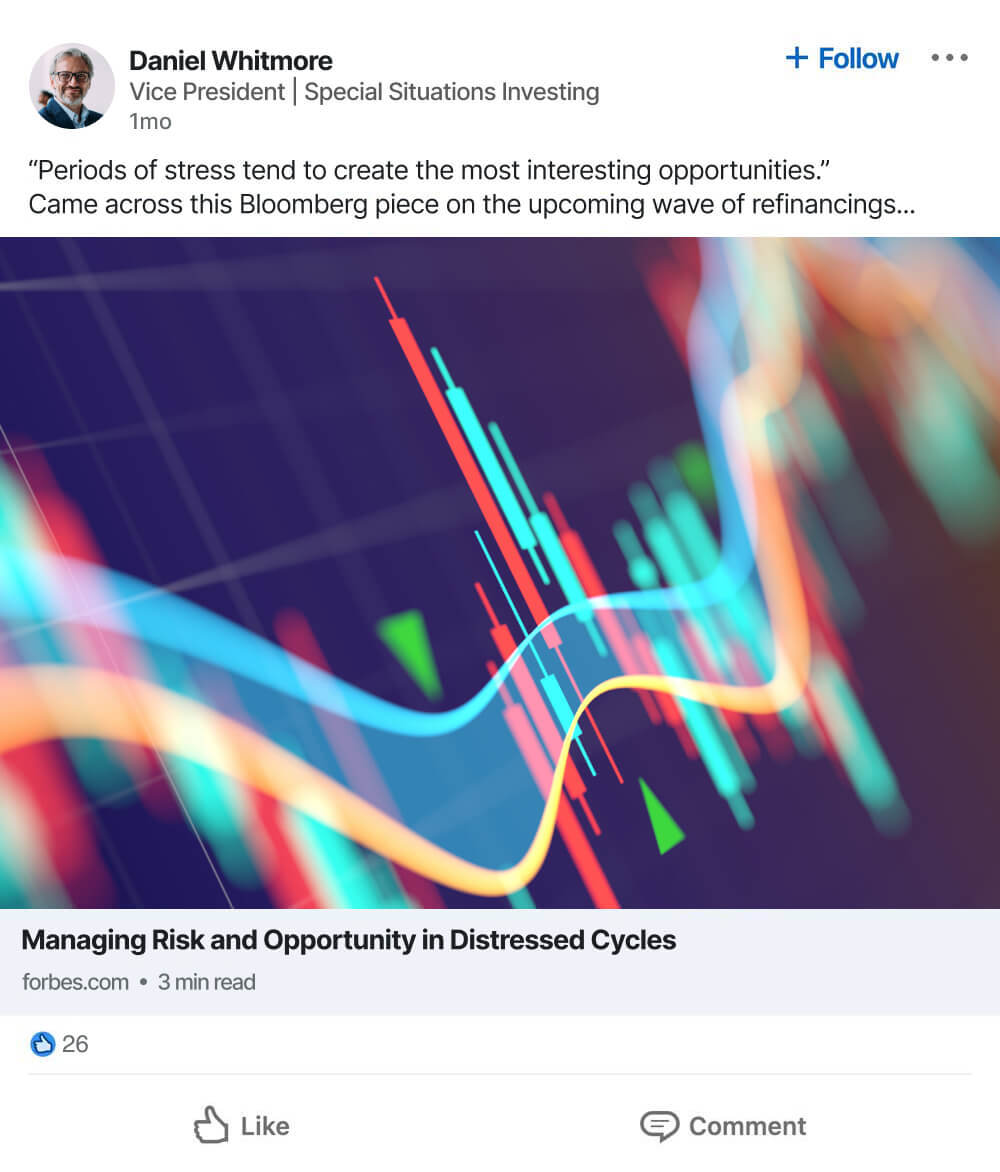
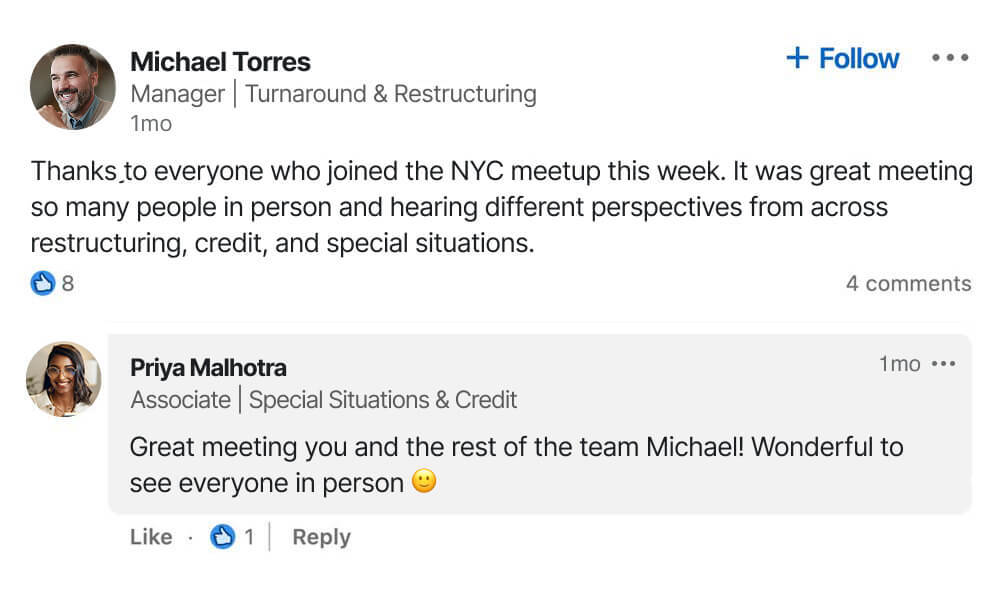
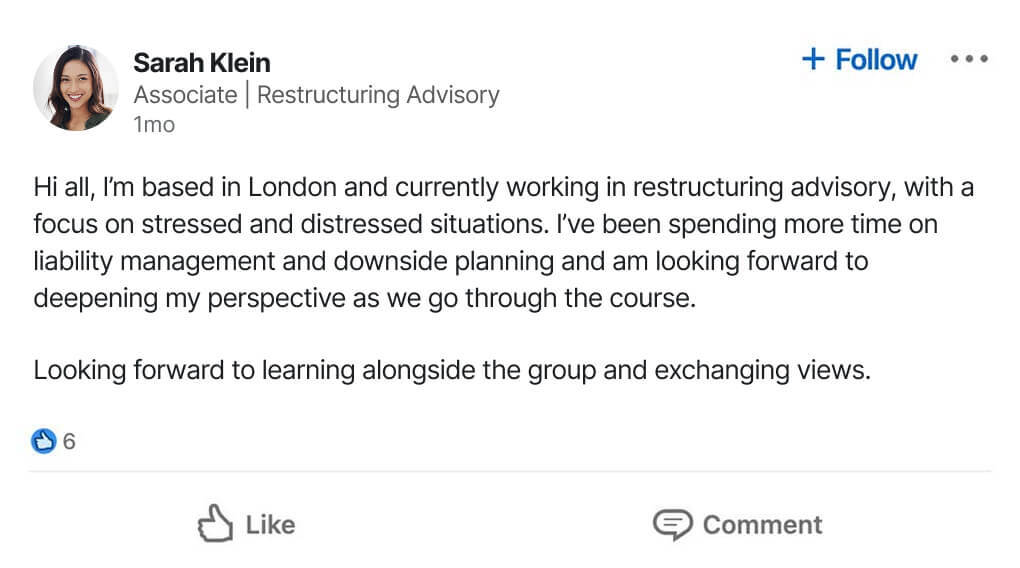
Invitation-Only Wharton/Wall Street Prep Group on LinkedIn
Participants receive an invitation to join the Wharton Online / Wall Street Prep Restructuring & Distressed Investing Certificate Program Group on LinkedIn. Here, graduates can connect with the entire program network, seek advice, and access exclusive online events and resources.


Local Connection for a Global Certificate
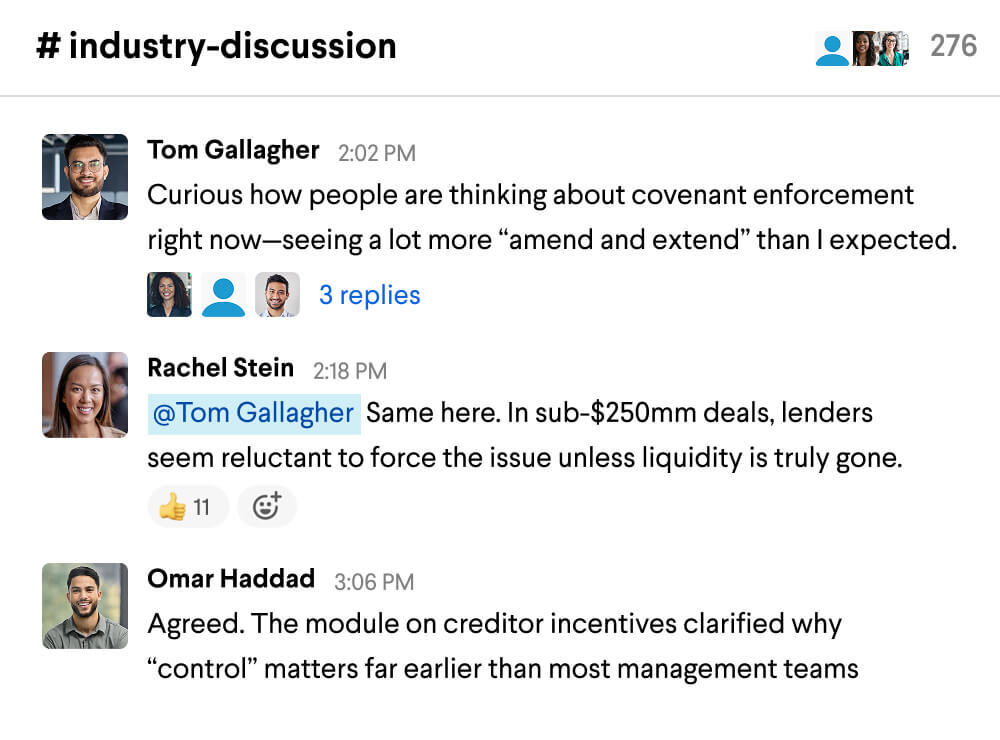
Program graduates come from 100+ countries, so while the program is global, connection is often created locally. Participants gain access to their Local Graduate Slack Channel, designed to facilitate local connection for a global certificate.
















































































Cross-Program Networking Events
Enrolling in a Wharton Online & Wall Street Prep Certificate Program is a unique opportunity to expand your professional network beyond your specific industry. Enrollees attend cross-program events attended by other Certificate Program learners and graduates in investment banking, private equity, hedge funds, asset management, venture capital, financial planning and analysis (FP&A) and other career tracks.
For Employers: Develop Restructuring & Distressed Investing Expertise Across Your Team
Private Equity, Credit & Special Situations
Build deal-ready distressed investors with practical modeling skills
- Train analysts and associates in distressed debt analysis, downside modeling, and restructuring frameworks
- Accelerate desk readiness through real-world case studies, LMEs, and applied investing tools
Investment Banks & Restructuring Advisory
Strengthen restructuring and special situations coverage
- Upskill teams across restructuring, leveraged finance, bankruptcy processes, and creditor dynamics
- Enable more effective advisory in complex, distressed client situations
Consulting, Accounting & Legal Firms
Support distressed and restructuring engagements with confidence
- Build practical restructuring fluency and improve collaboration with PE, credit, and banking clients

FAQs
How often are programs offered?
Programs will be offered three times each year. Cohorts will begin in February, June, and October.
How much time will it take to complete this certificate?
The course is designed to run for eight weeks, with a recommended workload of 8-10 hours of lectures, live sessions, and assignments per week.
What languages will the program be offered in?
This program is offered in English only.
How do I register for this program?
You can register for the program at any time through our Enrollment Form.
How much does the program cost?
Program tuition is $4,800. Tuition can be paid in full or in 5 monthly payments.
Do you offer tuition assistance?
Tuition assistance will be available for every cohort. Use our Tuition Assistance form to apply.
What is the program refund policy?
This program is non-refundable.
Who can I contact for additional questions?
If you have any additional questions, please reach out to our enrollment team at enrollment@wharton.wallstreetprep.com.