
Real Estate Investing & Analysis Certificate Program
In collaboration with

Get the full syllabus
View the full syllabus for details on faculty, guest speakers, and learner benefits.
Program overview
Level up your real estate investing career

Upon program completion, participants receive a digital certificate issued by Wharton Online


-
The world's most recognized real estate investing certificate program
Learn to analyze real estate investments, blending investment theory, with real world financial modeling and analysis as it is done at the world’s leading real estate investment firms.
-
Learn institutional-grade real estate analysis
The barriers to entry in real estate are low but the barriers to success are high. Learn to approach real estate with an institutional lens that will differentiate you as both a professional and entrepreneur.
-
Learn from world renowned faculty and experienced real estate investors
You'll learn directly from legendary faculty, industry practitioners and executives at some of the world's leading real estate firms.





Applicant profile
The Wharton & Wall Street Prep Real Estate Investing & Analysis Certificate Program is designed for finance professionals in their early to mid career seeking to understand institutional-grade real estate analysis.
Commercial Real Estate (CRE) Professionals
Investment Bankers
Brokers
Professional Services
Family Offices
Private Investors
Private Lenders
Support Roles
Career Switchers
Students
At a Glance:
Program Learners & Graduates


Applicant Career Levels
Applicant Industry
Countries Represented
Applicant Employers Include ...



















Top Roles Applicants Hold
| 1. | Real Estate Investment Analyst |
| 2. | Acquisitions Analyst |
| 3. | Asset Management Analyst/Associate |
| 4. | Asset Manager |
| 5. | Portfolio Manager |
| 6. | Loan Underwriter |
| 7. | Capital Markets Analyst/Associate |
| 8. | Financial Analyst |
| 9. | Investment Banking Analyst |
| 10. | Development Manager |

8-Week Program
Focusing on Real Estate
8-10 Hour Weekly
Time Commitment
Self-paced Online
Learning Experience
Learn By Doing
With Real Case Studies
How You'll Learn
How You'll Learn
The Wharton & Wall Street Prep Real Estate Investing & Analysis Certificate Program is an immersive learning experience made up of self-paced video lectures, real-world exercises, industry case studies and full faculty support.
Learn Directly From
Top Real Estate Investors
Tailored Learning
Through Electives
The Same Training Used
by Top Real Estate Firms
Weekly Office Hours
& Dedicated Support


Program curriculum
Over the course of eight weeks, you will learn the concepts and practical technical methods that real estate investment professionals deploy in analyzing and executing real estate transactions. Each week’s asynchronous learning is structured the same: Begin with a conceptual lecture that introduces new frameworks, vocabulary, and intuition. This is followed by a financial modeling lecture which applies the conceptual learnings in Microsoft Excel, turning concepts into math. A guest lecture and case study discussion then provide real world context and illustrate how the week’s learnings impact decision making in real estate investing. This is all supported with live weekly 1:1 office hours, group office hours, and case study discussion. Delivered in a weekly self-paced online format, the program culminates in a closing ceremony and the receipt of a Certificate from Wharton Online.
Module 1
Introduction to Real Estate 101
Module 1 builds the foundation for the program. We begin with the evolution of real estate private equity, then introduce real estate as an asset class and the core investment frameworks used by professionals. The module concludes with an introduction to financial modeling and investment memo writing to prepare participants for the case study project.
- Evolution of real estate private equity and key industry milestones
- Real estate as an asset class: property types and investment strategies
- Investment framework: NOI, valuation methods (DCF, cap rates, comparables), pro formas, and return metrics
- Introduction to financial modeling: purpose, structure, and best practices
- Investment memos 101: structuring clear, effective recommendations
Module 2
Introduction to Real Estate 102
Module 2 builds on the foundational investment framework by shifting from theory to application. Learners explore how practitioners evaluate opportunities and begin a deep dive into modeling core real estate cash flows, with a focus on revenue projections across major property types.
- Applying the real estate investment framework from a practitioner’s perspective
- Modeling multifamily revenue projections
- Modeling commercial (office, retail, industrial) revenue projections
- Real estate private equity in practice: middle-market investment strategy and platform structure
Module 3
Executing Real Estate Deals
Module 3 shifts from the “why” of investing to the “how” of execution. Learners are immersed in the real-world mechanics of sourcing, negotiating, and closing transactions, while completing the build-out of core and non-operating cash flows within a financial model.
- The stages of a real estate transaction, from sourcing through closing
- Roles and responsibilities across the deal team and key third parties
- Modeling multifamily and commercial operating expense projections
- Refining NOI and understanding its relationship to valuation
- Modeling non-operating cash flows, including capex and leasing costs
Module 4
Leveraging Debt Financing
Module 4 focuses on how real estate transactions are capitalized and structured. Learners examine leverage, key tax considerations, and joint venture partnerships, then apply these concepts by modeling debt and analyzing levered returns.
- Capital structures and the role of leverage
- Core tax considerations in real estate investing
- Introducing joint venture structures and incentive alignment
- Building amortization schedules
- Modeling debt and analyzing levered cash flow
Module 5
Structuring Equity Partnerships
Module 5 turns to the equity side of the capital stack. Participants explore how joint venture partnerships are structured, how incentives are aligned between capital and operating partners, and how equity returns are distributed. The module culminates in modeling partnership structures and building distribution waterfalls.
- Equity structures, including cash equity and sweat equity
- Aligning incentives within joint venture partnerships
- Fundamentals of real estate waterfalls
- Modeling joint ventures and distribution waterfalls
- Practitioner perspectives on partnerships, negotiations, and cycles
Module 6
Market Analysis & Informed Decision Making
Module 6 focuses on how market fundamentals inform underwriting assumptions. Participants explore real estate cycles, supply and demand dynamics, and the interplay between macro and micro factors. The module emphasizes using the financial model as a decision-making tool by refining assumptions, summarizing outputs, and analyzing key metrics across scenarios.
- Real estate cycles and supply-demand dynamics
- Incorporating macro and micro trends into underwriting assumptions
- Summarizing model outputs and calculating key return metrics
- Stress-testing assumptions and analyzing multiple scenarios
- Practitioner perspectives on market data, forecasting, and investment strategy
Module 7
Assessing Risks & Opportunities
Module 7 centers on investment judgment and risk assessment. Participants examine asset-level and capital structure risks, learn how to measure and mitigate them using underwriting tools, and refine their ability to think like disciplined real estate investors. The focus shifts from building models to interpreting them in the context of real-world uncertainty.
- Identifying common asset-level and market risk factors
- Measuring risk using underwriting models across property types
- Capital structure risk, including debt maturity analysis
- Strategies for mitigating downside while preserving upside
- Leadership perspective from a global real estate investment platform
Module 8
Real Estate Development
Module 8 shifts from acquiring existing assets to building new ones. Participants explore the unique considerations involved in underwriting development projects, including construction budgets, lease-up assumptions, and development financing. The program culminates with the submission of the Capstone Case Study, integrating concepts from across all eight modules.
- Key differences between acquisition and development models
- Development budgets, timelines, and major cost categories
- Modeling lease-up, stabilization, and operating shortfalls
- Construction financing, interest reserves, and funding mechanics
- Executive perspective on leading large-scale development projects
Capstone Case Study
Investment Case Study
The Capstone Case Study is the culmination of the program, bringing together all technical and strategic concepts into a single, real-world investment exercise. Participants step into the role of an investment professional and execute the full process: diligence, underwriting, market research, investment thesis development, and memo writing.
Based on a real transaction, the case includes a broker call and real data room. Final deliverables include:
- Investment memo
- Financial model
- Due diligence quiz
Faculty & speakers
-
Todd Sinai
![Company logo]() Chair, Real Estate Department, Wharton SchoolView Bio
Chair, Real Estate Department, Wharton SchoolView Bio -
Benjamin J. Keys
![Company logo]() Rowan Family Foundation Professor in Real Estate and Finance, Wharton SchoolView Bio
Rowan Family Foundation Professor in Real Estate and Finance, Wharton SchoolView Bio -
Jessie Handbury
![Company logo]() Gilbert and Shelley Harrison Associate Professor in Real Estate, Wharton SchoolView Bio
Gilbert and Shelley Harrison Associate Professor in Real Estate, Wharton SchoolView Bio -
Aaron Hancock
![Company logo]() Real Estate Investing & Analysis Program Director, Wall Street PrepView Bio
Real Estate Investing & Analysis Program Director, Wall Street PrepView Bio -
Daniel Mann
![Company logo]() Real Estate Investing & Analysis Program Director, Wall Street PrepView Bio
Real Estate Investing & Analysis Program Director, Wall Street PrepView Bio -
Aaliyah Ameer
![Company logo]() View Bio
View Bio -
Karine Blanc
![Company logo]() View Bio
View Bio -
Daniel Erb
![Company logo]() View Bio
View Bio -
Matan Feldman
![Company logo]() View Bio
View Bio -
JB Gough
![Company logo]() View Bio
View Bio -
Lindsay Tsumpes
![Company logo]() View Bio
View Bio


-
Dean Adler
![Company logo]() Founder and CEO, Lubert-AdlerView Bio
Founder and CEO, Lubert-AdlerView Bio -
Eric Bergin
![Company logo]() Managing Member, 3E ManagementView Bio
Managing Member, 3E ManagementView Bio -
Jeff T. Blau
![Company logo]() CEO, Related CompaniesView Bio
CEO, Related CompaniesView Bio -
Anar Chudgar
![Company logo]() President, Artemis Real Estate PartnersView Bio
President, Artemis Real Estate PartnersView Bio -
Matan Feldman
![Company logo]() View Bio
View Bio -
Hal Fetner
![Company logo]() President & CEO, Fetner PropertiesView Bio
President & CEO, Fetner PropertiesView Bio -
Chris Lee
![Company logo]() Co-President & Partner, KKR Real EstateView Bio
Co-President & Partner, KKR Real EstateView Bio -
Evan Levy
![Company logo]() Vice Chairman, The Amherst GroupView Bio
Vice Chairman, The Amherst GroupView Bio -
Christopher Méndez
![Company logo]() Managing Director, PearlmarkView Bio
Managing Director, PearlmarkView Bio -
Alan Ratner
![Company logo]() Managing Director of Equity Research, Zelman & AssociatesView Bio
Managing Director of Equity Research, Zelman & AssociatesView Bio -
Michael Vu
![Company logo]() Senior Managing Director, Artemis Real Estate PartnersView Bio
Senior Managing Director, Artemis Real Estate PartnersView Bio -
Simon Ziff
![Company logo]() President, Ackman-Ziff Real Estate GroupView Bio
President, Ackman-Ziff Real Estate GroupView Bio










Attend an information session
Tuition & payment options
OR
Join a Global Network
Enrollees access a large and highly engaged global network of peers who are committed to give us much as they get and to support one another. Connections built throughout the program are strengthen via in person and virtual meetups, discussion groups and networking events.

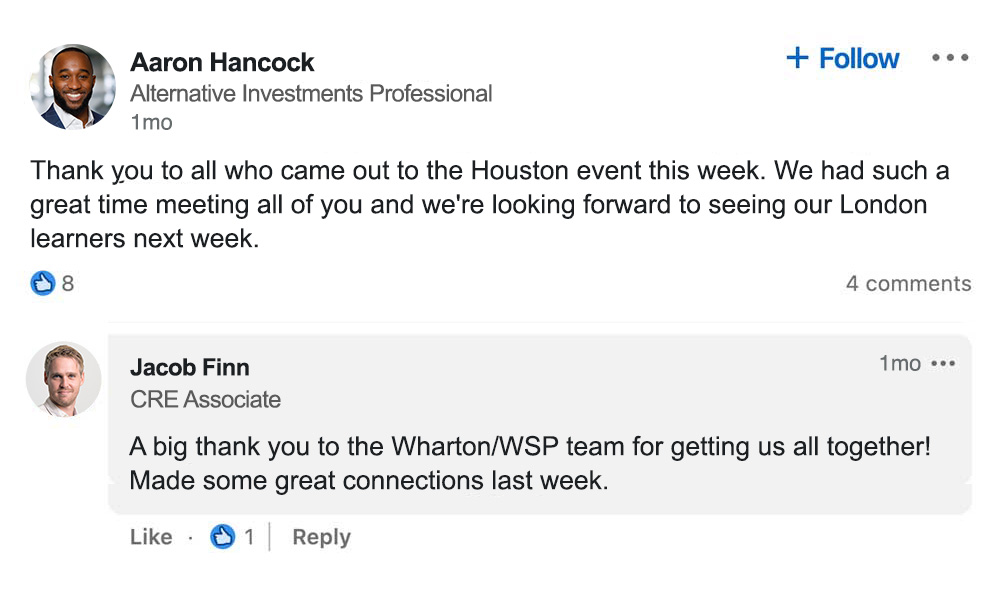

Invitation-Only Wharton/Wall Street Prep Group on LinkedIn
Upon completion of the program, graduates receive an invitation to join the Wharton Online / Wall Street Prep Real Estate Investing & Analysis Certificate Program Alumni Group on LinkedIn. Through this group, graduates can directly connect with the entire graduate network, seek advice and access graduate-only online events and resources.


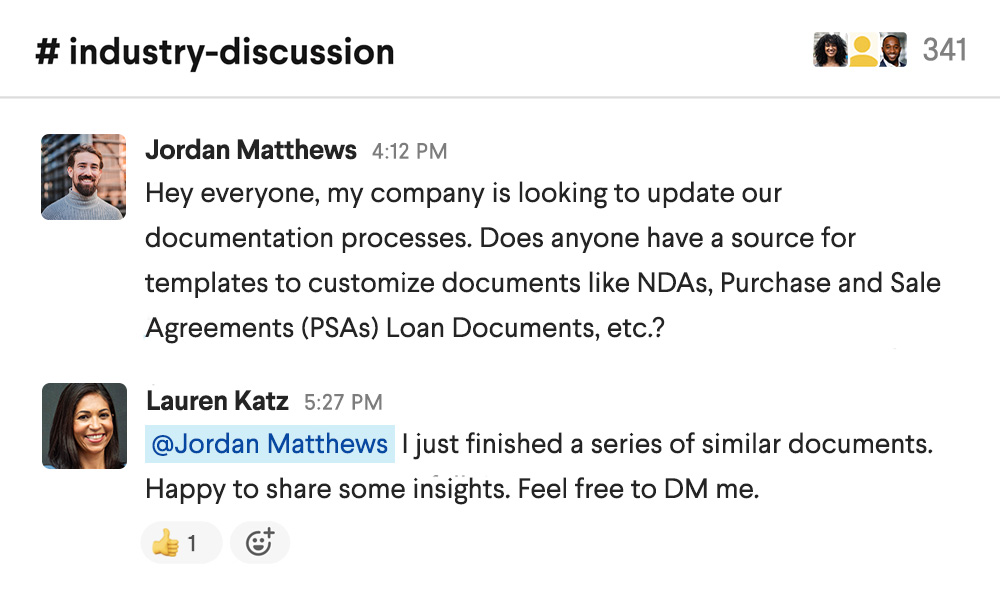
Local Connection for a Global Certificate
Program graduates come from over 40 countries, so while the program is global, connection is often created locally. Graduates gain access to their Local Alumni Slack Channel, designed to facilitate local connection for a global certificate.


Cross-Program Networking Events
Enrolling in a Wharton Online & Wall Street Prep Certificate Program is a unique opportunity to expand your professional network beyond your specific industry. Enrollees attend cross-program events attended by other Certificate Program learners and graduates in investment banking, private equity, hedge funds, asset management, venture capital, financial planning and analysis (FP&A) and other career tracks.
For Employers: Level up your professional development
Real Estate Private Equity Firms
- Accelerate the new hire training timeline.
- Better compete for talent against large firms with extensive in-house training resources.
Owner/Operators & Developers
- Institutionalize your underwriting and diligence processes.
- Grow your portfolio by creating efficiencies in your execution processes.
Vendors
- Better understand how your services and products fit into the real estate investment process.
- Equip your sales force to recognize opportunities to add value across your client’s investment processes.

FAQs
How often are programs offered?
Three cohorts run each year, starting in February, June, and October. Seats fill on a first-come basis. Reserve your seat before the early enrollment deadline to take $200 off tuition.
How much time will it take to complete this certificate?
Eight weeks at 8-10 hours per week, designed around a full-time job. The self-paced format lets you work on your own schedule, with weekly live office hours for direct support. The program follows a fixed cohort calendar; the final assessment and certificate are issued at the end of the eight-week window.
How do I register for this program?
Enrollment is open for the upcoming cohort. Secure your seat through the enrollment form. If you have questions before committing, book a 15-minute call with an enrollment advisor.
How much does the program cost?
Tuition is $5,000, payable in full or in five $1,000 installments. Take $200 off by enrolling before the early enrollment deadline. If you're unable to complete the program for any reason, you're automatically re-enrolled one time in the immediately following cohort at no additional cost, so your investment is protected. Tuition assistance and employer reimbursement options are covered below.
Will my employer pay for the program?
Many participants expense the program as professional development. We can provide a template reimbursement letter, request an invoice routed to your employer, or share a direct payment link for your finance team. See our employer reimbursement guide for help positioning the request internally.
Do you offer tuition assistance?
Yes. $550 in tuition assistance is available for every cohort with no income or background requirements. Apply before enrolling. See the employer reimbursement FAQ above for additional options.
What is the program refund policy?
Enrollment is non-refundable. If you can't complete the program for any reason, you're automatically re-enrolled one time in the immediately following cohort at no additional cost.
Is this program right for me if I don't have a finance background?
The program is built for finance professionals deepening their expertise and for non-finance professionals whose roles require fluency in the subject matter. The curriculum starts with foundational concepts before building into advanced material. An enrollment advisor can assess fit on a 15-minute call.
What do I actually get when I complete the program?
A digital certificate from Wharton Online for LinkedIn and your resume, plus CPE credits registered with NASBA. You also join a network of 5,000+ graduates across finance, consulting, and professional services, with access to a program-specific alumni LinkedIn group, local Slack channels by geography, and in-person recruiting and industry events.
Who can I contact for additional questions?
Email our enrollment team at enrollment@wharton.wallstreetprep.com or book a 15-minute call with an enrollment advisor who can walk through curriculum, fit, financing, and employer reimbursement.